
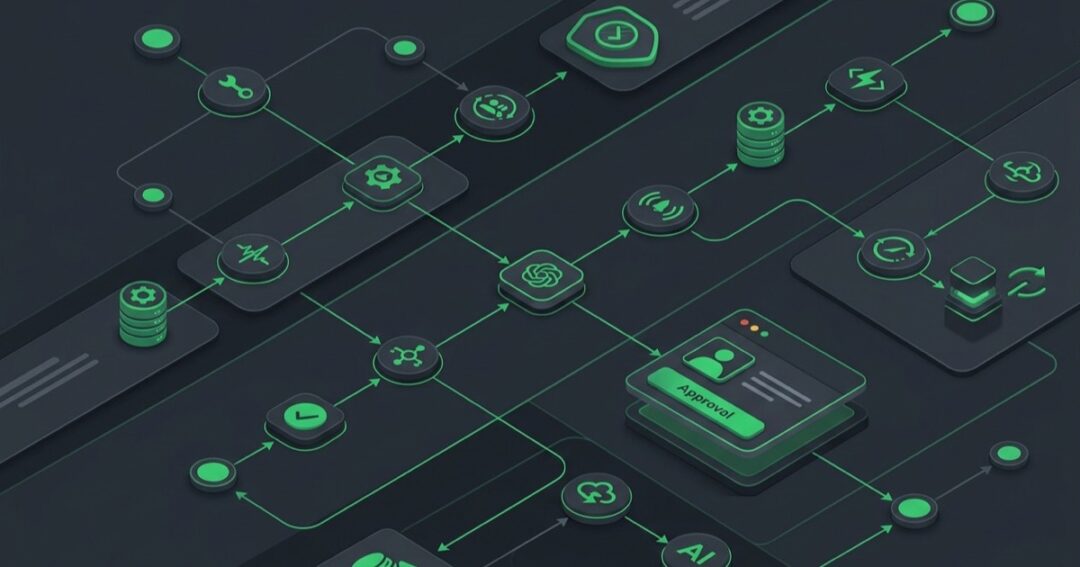
Most business leaders do not need another generic AI demo. They need work to move faster without creating a new operational risk. That is where agentic AI systems become useful: they are designed to take a defined business process, connect it to the right knowledge and tools, perform bounded work, and escalate when human judgment is required.
For greenstar technology, the useful question is not “Can AI answer a question?” The useful question is “Can this workflow run more consistently, with better visibility, less manual follow-up, and clear control points?”
Agentic AI is a workflow layer, not a magic employee
An agentic AI system combines several pieces that already exist in most organizations: documents, applications, messages, tickets, databases, approvals, and operating rules. The agent layer sits across those systems and handles the repeatable coordination work that normally burns time between teams.
A practical system might monitor an inbox, classify requests, pull context from internal documentation, prepare a response, open or update a ticket, route an exception to the right person, and keep a visible audit trail. The value is not the model by itself. The value is the system around the model.
What these systems actually do
Inside a business operation, a well-designed agentic AI system usually handles five kinds of work.
1. Intake and triage
Many processes start with messy input: emails, forms, chat messages, call notes, spreadsheet rows, or support requests. An agentic workflow can identify what the request is about, check whether required information is missing, classify priority, and route it to the correct lane.
2. Context retrieval
Before a person acts, they often need to search through documentation, old tickets, contracts, policies, system notes, or customer history. An agentic AI system can retrieve that context and present a grounded summary with links back to the source material.
3. Tool execution
The real operational gain appears when the system can safely use tools: create a task, update a CRM record, check status in a dashboard, compare records, draft a reply, or run a known internal script. This is where agentic AI starts turning knowledge into action.
4. Monitoring and escalation
Automation should not mean invisible work. Strong systems monitor their own outputs, detect missing data, identify exceptions, and escalate with enough context for a human to decide quickly. The goal is fewer dropped handoffs, not blind autonomy.
5. Evidence and auditability
If a workflow matters, the business needs proof of what happened. Agentic systems should leave behind timestamps, decisions, source references, changed records, and verification notes. This matters for regulated communications, security operations, customer support, finance, and any process where control is as important as speed.
Where agentic AI fits best
The best starting points are repetitive, high-friction workflows where humans spend too much time moving information between systems. Good candidates include support intake, project status updates, compliance follow-up, report preparation, document review, operations monitoring, sales admin, knowledge-base support, and internal service desks.
The wrong starting point is a vague instruction like “make our company more AI powered.” The right starting point is a process with clear inputs, clear outcomes, known exceptions, and a measurable cost of delay or manual effort.
How to keep control
Agentic AI should be designed with operating boundaries from day one. A safe implementation defines what the system can read, what it can change, what it must never do, when it needs approval, where it records evidence, and how a human can override or stop the workflow.
That control model is especially important for organizations dealing with regulated communications, customer data, infrastructure changes, or business-critical delivery. In those environments, the question is not whether automation is possible. The question is whether it can be governed well enough to trust.
A practical implementation path
greenstar technology recommends starting with a narrow operational workflow instead of a broad AI transformation program. Pick one process, map the current handoffs, identify the systems involved, define the approval points, and build a small agentic workflow that can be tested against real cases.
- Define the business outcome and failure modes.
- Document the source systems, data rules, and human approval points.
- Build the first workflow around read, draft, route, and record actions.
- Add tool execution only where permissions and rollback paths are clear.
- Measure cycle time, exception rate, manual touches, and quality of handoff.
This is the same delivery mindset greenstar technology brings to technology solutions, cloud transformation, voice systems, and complex operational programs. The system has to work under real business pressure, not just in a demo.
What success looks like
A successful agentic AI system does not replace every person in a process. It removes avoidable drag. Requests are classified faster. Context is easier to find. Routine steps are completed consistently. Exceptions are escalated with the right facts. Leaders can see what is moving and what is blocked.
For example, the same operating discipline used in automated call testing for trader voice and SIP migration applies to AI workflows: define the expected behavior, test at scale, capture evidence, and escalate failures before they become business problems.
Start with the process, then add the agents
Agentic AI becomes valuable when it is tied to a real operating model. The best systems are not built around hype. They are built around the work: the data, the handoffs, the approval points, the systems of record, and the proof that the business needs in order to trust the result.
If your team is ready to modernize a repetitive workflow without losing control, greenstar technology can help identify the right first use case, design the control model, and build an agentic AI system that fits the way your operation actually runs.